
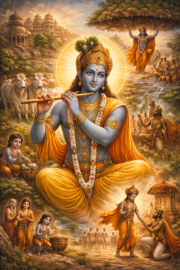
Krishna is one of the most central and beloved figures in Hinduism. Revered as an avatar of Vishnu, a divine teacher, a heroic king, and a playful cowherd, Krishna occupies a place of immense theological, literary, and devotional significance. Yet alongside this religious prominence lies a historical question: was Krishna a real historical individual, or is he primarily a mythic and theological figure shaped by centuries of tradition?
Scholars approach this question carefully, distinguishing between Krishna as a figure of faith and the possibility of a historical person behind the traditions.
What Hindu texts say about Krishna
Krishna appears across a wide range of Hindu literature, composed over many centuries. These texts are not historical biographies in the modern sense, but theological and epic narratives that combine myth, devotion, and moral teaching.
The Mahābhārata
The Mahābhārata (compiled roughly between 400 BCE and 400 CE, with earlier layers) presents Krishna as a prince of the Yādava clan, a kinsman and ally of the Pāṇḍavas, and a key political and military figure. He serves as a diplomat, strategist, and charioteer. The Bhagavad Gītā, embedded within the epic, portrays Krishna as a divine teacher who reveals profound metaphysical truths to Arjuna.
The Bhāgavata Purāṇa and Harivaṃśa
Later texts, especially the Bhāgavata Purāṇa (c. 9th–10th century CE), emphasize Krishna’s divine childhood and youth—his miraculous birth, cowherd life in Vṛndāvana, playful exploits, and devotional appeal. The Harivaṃśa, often regarded as a supplement to the Mahābhārata, elaborates Krishna’s genealogy and life narrative.
Across these texts, Krishna is consistently portrayed as divine, performing miracles, defeating demons, and embodying cosmic principles. The primary purpose of these writings is theological and devotional, not historical documentation.
When would Krishna have lived, if he did?
Traditional Hindu chronology often places Krishna at the end of the Dvāpara Yuga and dates his life to around 3102 BCE, the conventional beginning of the Kali Yuga. This date is derived from later calendrical and cosmological calculations rather than from contemporaneous historical records.
Modern historians and Indologists generally regard this traditional date as symbolic rather than historical. If a historical Krishna existed, scholars typically suggest a much later timeframe, often somewhere between 1500 and 1000 BCE, broadly aligning with the late Vedic or early epic period. These estimates are tentative and depend on reconstructions of early Indian political and social history rather than firm evidence.
Is there historical or archaeological evidence?
There is no direct archaeological or epigraphic evidence that can be securely linked to Krishna as an identifiable historical individual. No contemporary inscriptions, coins, or material remains name Krishna in a way that would function as historical proof.
Some indirect evidence is often discussed:
• Early clan references: Texts mention the Yādavas, Vṛṣṇis, and Andhakas as real clans or tribes, which may reflect historical social groups in northwestern India.
• Early devotion: By the early centuries BCE, inscriptions and literary sources attest to the worship of Vāsudeva-Krishna, suggesting that devotion to Krishna had become well established.
• Heliodorus Pillar (c. 2nd century BCE): This inscription refers to Vāsudeva as a god worshiped by a Greek ambassador, demonstrating early Krishna devotion but not proving the historicity of the figure himself.
Such evidence supports the antiquity of Krishna worship, not the historical existence of Krishna as a biographical person.
Scholarly perspectives on the historical Krishna
Modern scholarship is divided, though with important points of consensus.
Krishna as a composite figure
Many scholars argue that Krishna is best understood as a composite figure formed through the merging of multiple traditions:
• A heroic tribal leader or chieftain remembered in early epic lore
• A pastoral deity associated with fertility and abundance
• A supreme divine teacher identified with Vishnu
Over time, these strands were woven together into a single theological figure.
Minimalist and maximalist positions
• Minimalists maintain that there is insufficient evidence to affirm the existence of a historical Krishna. From this view, Krishna is primarily a mythological and theological construct, shaped by epic poetry and devotional needs.
• Moderate or maximalist scholars allow for the possibility that an early heroic figure named Krishna or Vāsudeva inspired later traditions, though they stress that almost nothing concrete can be recovered about his life.
Unlike figures such as the Buddha, whose existence is supported by relatively early independent textual and archaeological evidence, Krishna lacks external corroboration from near-contemporary sources.
Comparative religion perspective
Scholars of religion often compare Krishna to other foundational religious figures whose narratives blend history and myth. From this standpoint, the historical question is less central than the role Krishna plays in shaping religious identity, ethics, and devotion. Whether or not a historical Krishna can be reconstructed, the Krishna of the texts functions as a powerful theological symbol.
The distinction between history and faith
For Hindu devotees, Krishna’s historical existence is often secondary to his spiritual reality. Bhakti traditions emphasize Krishna’s presence, grace, and relational accessibility rather than historical verification. Academic scholarship, by contrast, limits itself to what can be established using historical methods.
These two approaches are not necessarily in conflict, but they operate with different assumptions and goals.
Conclusion
The question “Was Krishna a historical figure?” does not yield a definitive answer. Hindu texts present Krishna as a divine hero whose life unfolds within a mythic and epic framework. Traditional chronologies place him deep in antiquity, while modern scholarship views such dates as symbolic. No direct historical evidence confirms Krishna’s existence as a discrete historical individual.
Most scholars conclude that Krishna is best understood as a composite figure whose worship emerged from early social, religious, and devotional movements in ancient India. While a historical kernel cannot be ruled out, it cannot be demonstrated with confidence. What is beyond dispute, however, is Krishna’s immense influence: as a theological figure, literary presence, and devotional focus, Krishna has shaped Hindu thought and practice for more than two millennia, regardless of the limits of historical reconstruction.

