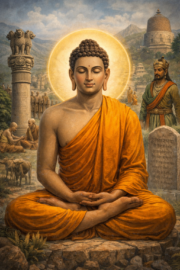
Siddhartha Gautama, commonly known as the Buddha, stands at the center of one of the world’s major religious traditions. Unlike figures grounded in modern documentary history, the Buddha belongs to a distant oral culture in which biography, teaching, and legend were transmitted for centuries before being written down. As a result, historians approach his existence with careful methodological restraint. The question is not whether the later Buddhist tradition embellished his life—it clearly did—but whether there is sufficient historical evidence to affirm that Siddhartha Gautama was a real individual who lived and taught in ancient India.
Most scholars answer that question in the affirmative, though with important qualifications.
Chronological and cultural context
The Buddha is traditionally dated to the late sixth or early fifth century BCE. Modern scholarship typically places his lifetime approximately between 480 and 400 BCE, though dates ranging from the late seventh to the early fourth century have been proposed. He is said to have lived in the eastern Gangetic plain, an area characterized by small kingdoms, republics, and a vibrant culture of ascetic experimentation.
This period saw the rise of śramaṇa movements—renunciant traditions that rejected Vedic ritualism in favor of meditation, ethical discipline, and liberation from rebirth. Jainism, Ajivika traditions, and early Buddhism all emerged within this milieu. The existence of such a setting is independently confirmed by archaeology, early Indian literature, and later Greek accounts of India.
The primary literary evidence
The most important evidence for the Buddha’s existence comes from early Buddhist texts, preserved in multiple languages and traditions.
The Pāli Canon
The Pāli Canon, especially the Sutta Piṭaka and Vinaya Piṭaka, contains the earliest extensive accounts of the Buddha’s teachings and community. These texts were transmitted orally for several centuries before being committed to writing, likely in Sri Lanka in the first century BCE.
While the Canon is religious literature rather than biography, it presents a consistent picture of a teacher named Gotama (Gautama), a renunciant who taught a distinctive path centered on the Four Noble Truths, the Eightfold Path, and dependent origination. The texts situate him among identifiable contemporaries—kings, rival teachers, and locations—which lends them historical plausibility.
Multiple independent traditions
Crucially, early Buddhist materials survive in several recensions: Pāli, Sanskrit, Gandhārī, and Chinese translations of lost Indian originals. Comparative study shows that many core teachings and narrative elements appear across these independent transmission lines. This convergence suggests that they derive from an early common source rather than later invention.
Historians generally regard teachings that appear across multiple early traditions as more likely to reflect the historical Buddha, even if their exact wording cannot be recovered.
Archaeological and epigraphic evidence
There is no direct archaeological artifact that can be securely attributed to Siddhartha Gautama himself. This absence is unsurprising given the period and the renunciant nature of his life. However, indirect archaeological evidence supports the early Buddhist narrative.
Ashokan inscriptions
The most significant non-literary evidence comes from the reign of Emperor Ashoka in the third century BCE. Ashoka’s inscriptions explicitly refer to the Buddha, his teaching (dhamma), and the Buddhist monastic community. Ashoka also identified sites associated with the Buddha’s life, such as Lumbini, traditionally regarded as the Buddha’s birthplace.
These inscriptions demonstrate that within two centuries of the Buddha’s presumed lifetime, a well-established tradition already existed that remembered a historical founder and specific locations associated with him.
Sacred sites and early stupas
Archaeological remains of stupas and monasteries at sites like Sarnath, Bodh Gaya, and Rajgir indicate early and widespread veneration tied to a remembered teacher. While archaeology cannot confirm the biographical details, it corroborates the existence of a movement centered on a specific individual.
Criteria historians use
Scholars apply standard historical criteria when evaluating the Buddha’s existence.
- Multiple attestation: Teachings and narratives appear across independent textual traditions.
- Contextual plausibility: The Buddha fits well within the known śramaṇa culture of his time.
- Explanatory power: The rapid emergence of a disciplined monastic movement is more plausibly explained by a charismatic founder than by gradual myth-making alone.
- Absence of viable alternatives: There is no competing historical explanation that accounts for early Buddhism without a founding teacher.
Taken together, these criteria strongly support the conclusion that Siddhartha Gautama was a historical figure.
Scholarly debates and conversations
What can we know about the Buddha?
While most scholars accept the Buddha’s existence, there is vigorous debate over how much can be known about his life and teaching. Some, often labeled “minimalists,” argue that only a small core of teachings can be reliably attributed to him. Others maintain that while details are uncertain, the broad contours of his life and doctrine are recoverable.
The problem of biography
Traditional biographies of the Buddha include miraculous elements—virgin birth motifs, supernatural powers, cosmic events—that scholars interpret as later hagiography. Historians generally strip these away to focus on a more modest figure: an itinerant teacher who achieved awakening through meditation and taught a practical path to liberation.
Unity versus diversity
Another debate concerns whether the Buddha taught a single coherent system or whether early Buddhism already contained significant doctrinal diversity. Textual evidence suggests that while core concepts were shared, interpretive variation arose very early, complicating attempts to reconstruct a single “original” Buddhism.
Comparison with other founders
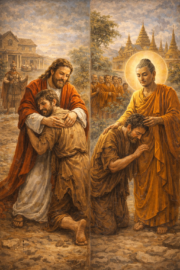
Scholars often compare the Buddha with figures such as Socrates or Jesus of Nazareth. Like them, the Buddha left no writings, is known primarily through followers’ accounts, and stands at the origin of a tradition that quickly developed theological depth. In all three cases, historians distinguish between the historical individual and the later religious portrait.
Conclusion
The historical evidence for the existence of Siddhartha Gautama is substantial by ancient standards. Although no contemporary inscription or artifact names him directly, early and independently transmitted texts, corroborated by archaeology and third-century BCE inscriptions, point convincingly to a real individual whose teachings inspired a durable religious movement.
Modern scholarship approaches the Buddha not as a figure of legend alone, nor as a fully recoverable biographical subject, but as a historically plausible teacher embedded in a well-attested cultural context. The ongoing scholarly conversation reflects both respect for the limits of historical inquiry and confidence that the Buddha was, in fact, a historical person whose influence continues to shape religious thought across the world.